About Lylac: How it works

This studio will house information about how Lylac works, to explain the features and functions that we have created for creative people, practices and communities.

created by @lylac

Writing 01

Welcome to Lylac

Lylac is a space for creative people to stay close to their work, their thinking and each other. Most platforms ask you to reduce what you do into outcomes, announcements, or polished fragments. Lylac is built differently. It is designed around studios : living spaces where process, references, notes, experiments, conversations and finished work can exist together, rather than being scattered across different corners of the internet. This studio is here to make that clearer. Think of it as a softer guide to what Lylac is for, how people use it, and why it exists in the first place. Not a manual. More like a room you can walk through.

Writing 02

Lylac in 1 sentence

Lylac is a digital studio for creatives. You can collect your work, sketches, links, writing, references and process into studios, and every studio becomes a beautiful shareable website.

Project 04

Digital studios built for creatives, image 1Digital studios built for creatives, image 2

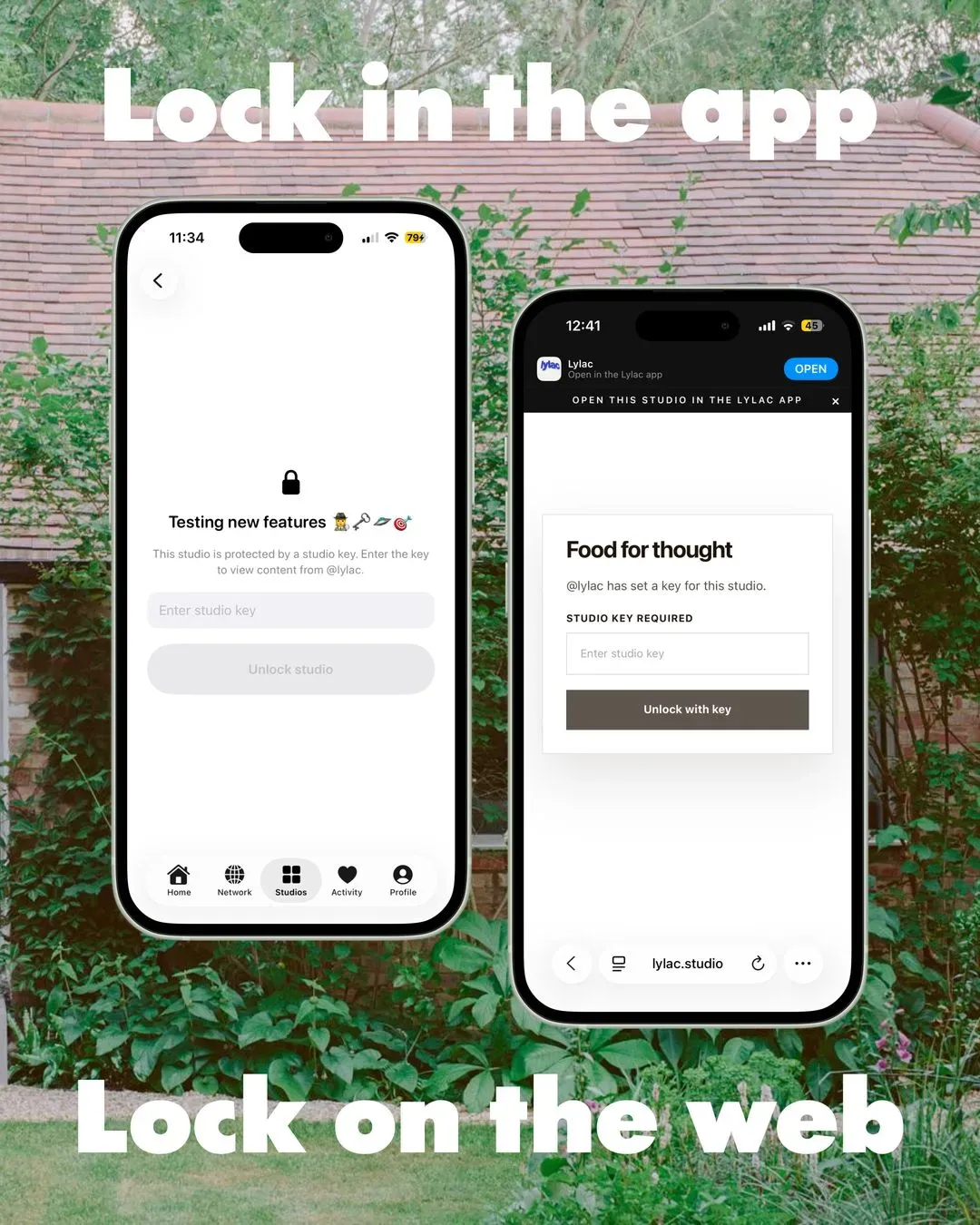
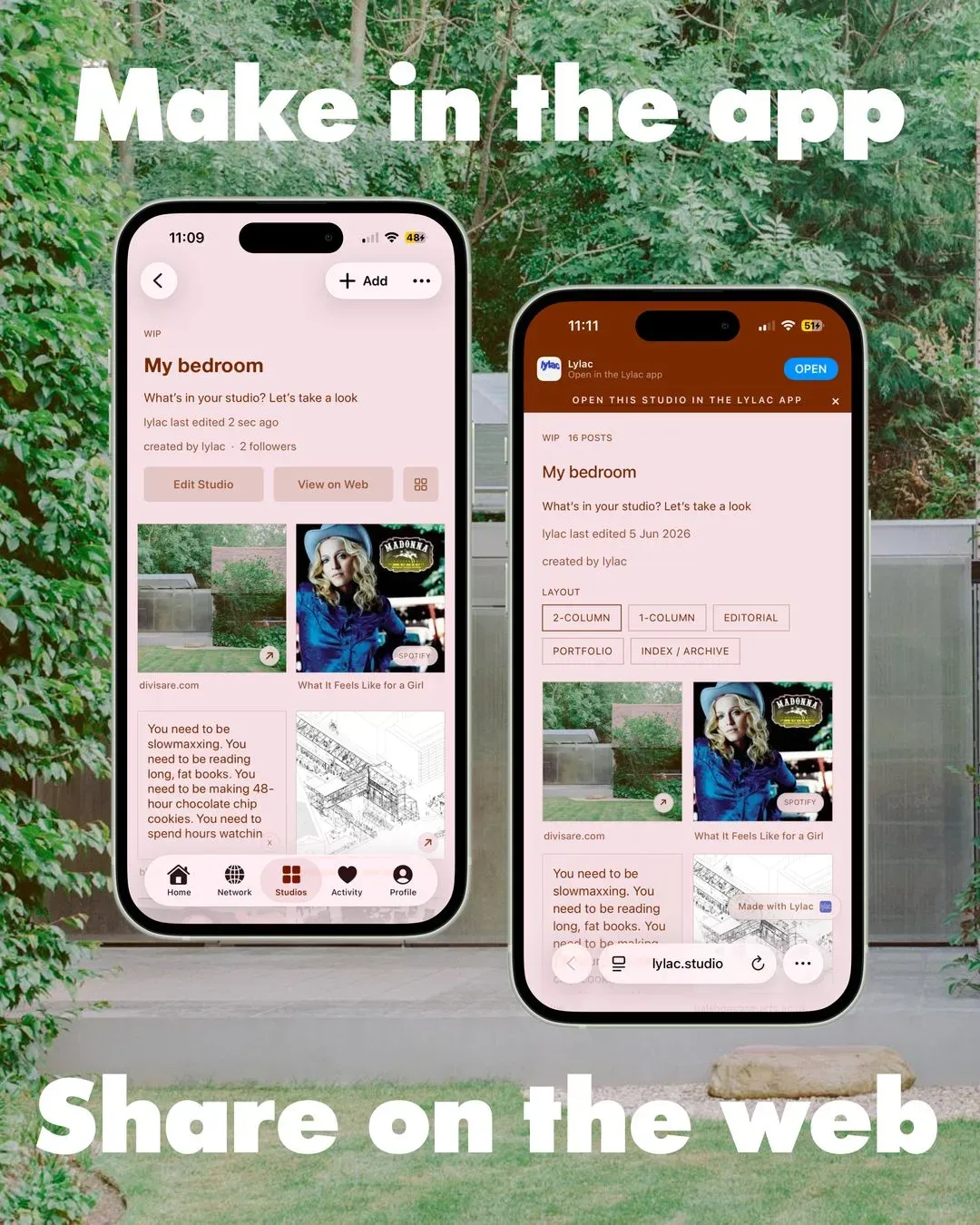
Lylac studios are designed for versatility for artists. Public studios automatically come with a web counterpart that you can send to employers, friends, your cat, and are updated automatically as you post/update your studio in the app. With the latest update enabling creatives to add links, studios just became way more helpful and can now be used like your creative linktree, a mood board, an archive, and a source of inspiration. I’ve also been adding more security to locked studios, allowing creatives to add password protection to their studios. This automatically applies the same level of protection to the web studio so you never have to worry about privacy or security.

Writing 05

Your profile is your creative home

Your profile brings your world together. It shows who you are, what you make, what you’re exploring, and which studios you’re part of. Instead of one flat grid, your profile can become a layered picture of your creative identity; your work, your interests, your collaborations, and your direction.

Link 06

Writing 07

Lylac is still growing

Lylac is being built carefully and intentionally. The goal is to create a healthier space for creative people, one that values context, process, discovery, collaboration, and genuine connection. This is the beginning of a wider creative network. Make studios. Share work. Save references. Follow what moves you. Build your world.

Writing 08

Collaboration

Studios can be collaborative. You can invite someone into a studio and build something together: a shared archive, a group project, a collective moodboard, a publication idea, a research space, or a visual conversation. Lylac is built for creative connection, not just broadcasting.

Writing 09

Saving posts into your own studios

When you find something that inspires you, you can save it into one of your own studios. This makes discovery feel useful, not disposable. Instead of losing good work in a feed, you can collect it, organise it, return to it, and let it become part of your own creative process. Since your studios can be public, private, open or closed, you can let others in on your creative journey and let it become a point of engagement and collaboration rather than a lonely pursuit.

Writing 10

Following studios

On Lylac, you don’t just follow people. You can follow studios. This means you can keep up with specific projects, collections, worlds, or areas of someone’s practice. Maybe you love someone’s photography studio, but also want to follow another person’s architecture research, another person’s poetry, and another person’s archive of visual references. Follow what actually interests you.

Writing 11

Public, private, and protected spaces

Not every idea needs to be public. You can use Lylac to share openly, keep things private, or create more protected spaces for specific people. Some studios can be made for discovery. Others can be used for personal research, quiet development, or work you only want certain people to see. Creative work needs different levels of openness.

Writing 12

Why studios matter

On most platforms, your work gets scattered across a feed. On Lylac, studios let you gather things together with context. A studio gives your work a place to live. It helps people understand what you’re making, what you’re thinking about, what you care about, and where your creative practice is heading.

Writing 13

What can you post?

You can post images, writing, thoughts, links, references, updates, research, process work, finished projects, experiments, and things you want to remember. Not everything has to be perfect. Lylac is designed for the in-between moments too, the sketches, the fragments, the references, the early ideas, and the work that is still becoming something.

Writing 14

What is a studio?

A studio is the main way things are organised on Lylac. You can use a studio as a portfolio, a scrapbook, a project space, a visual diary, a moodboard, a research folder, a collaboration space, or a small world for an idea. A studio can be polished or unfinished. Personal or professional. Public or private. Open or quiet. It’s yours to shape.

Writing 15

Why Lylac exists

Creative work already asks a lot of people. Time, energy, risk, uncertainty, self-belief. What it often does not give back is a stable environment to grow inside. So much of creative life now happens in fragmented digital spaces. References are saved in one place, outcomes are posted in another, conversations disappear elsewhere, and the pressure to keep showing up can start to outweigh the work itself. You can be visible without feeling supported. Lylac exists as a response to that. It is built for continuity, and a more serious kind of creative connection. The aim is not simply to help people post. It is to help creative people remain in conversation with their work and with one another.

Writing 16

Process matters here

On Lylac, process is not treated as secondary to the final piece. Sometimes the process is the work. Sometimes it is where the real intelligence sits: the decisions, the research, the revisions, the false starts, the references that end up shaping everything. In creative life, those parts are often more revealing than the polished outcome alone. That is one of the reasons studios matter. They let work unfold properly. They make room for development, not just display. They help other people understand not only what you made, but how you arrived there, and that can open the door to better feedback, better conversation, and more meaningful forms of recognition.

Writing 17

Studios as physical spaces: STUDIO MODES

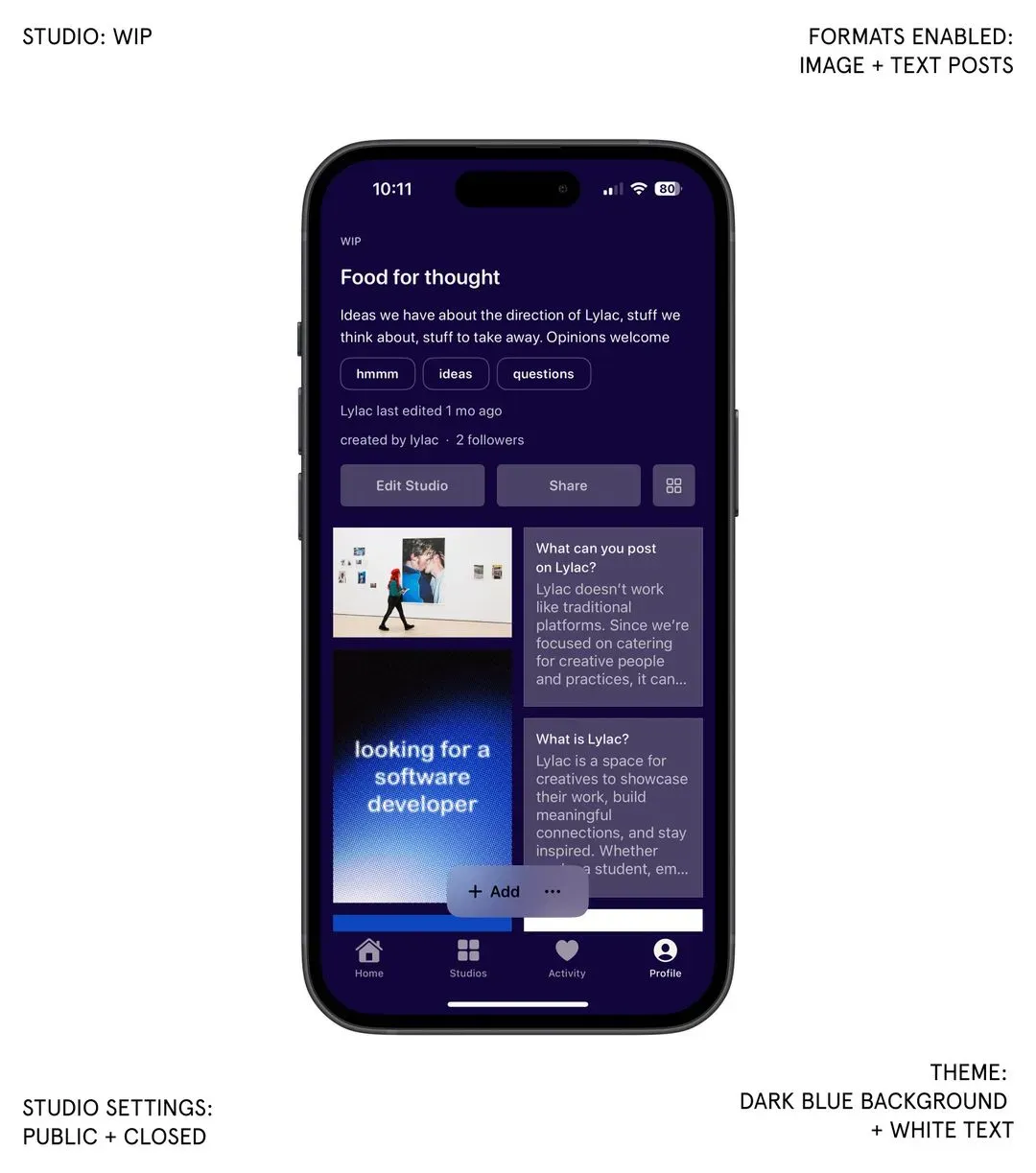
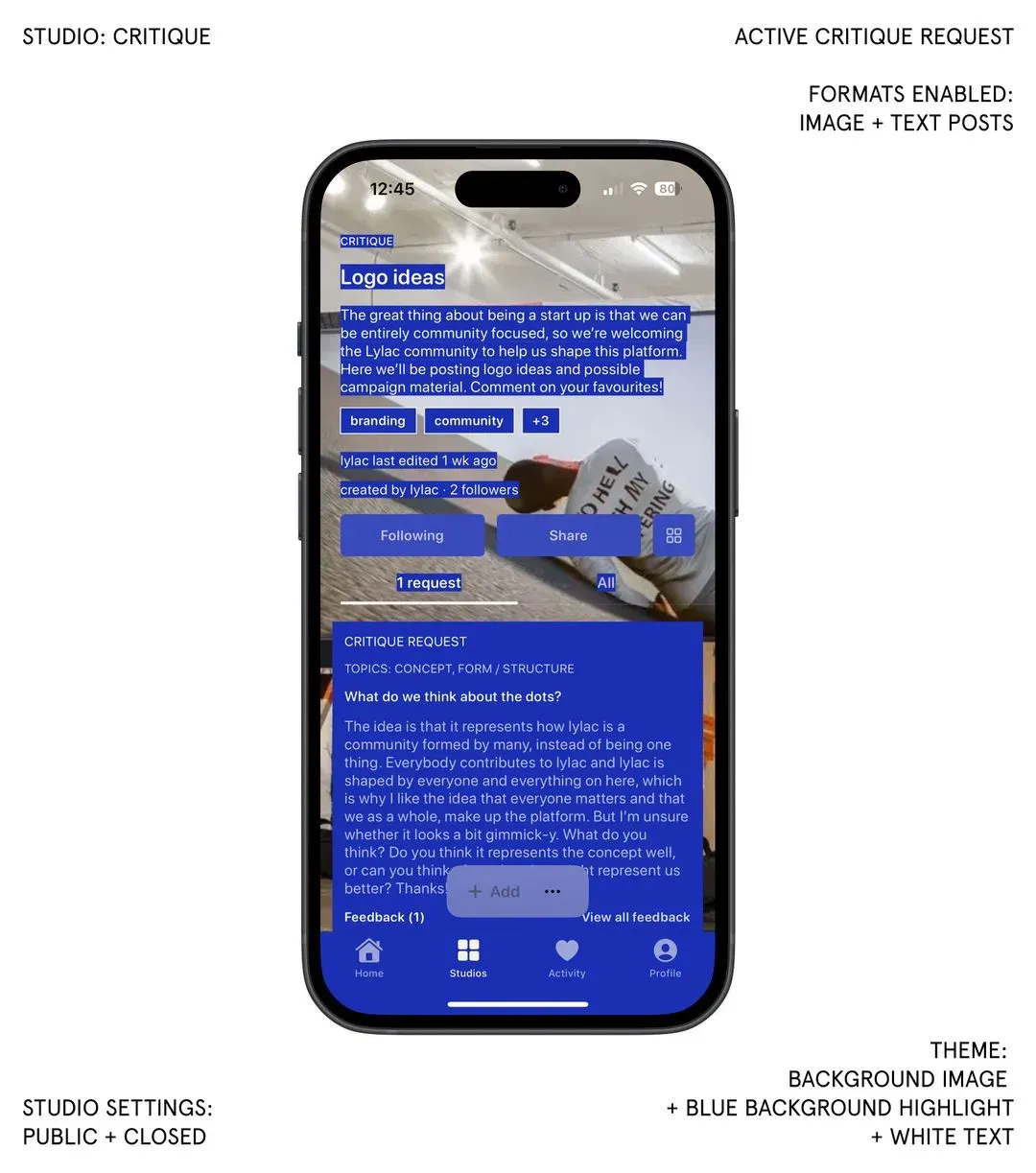
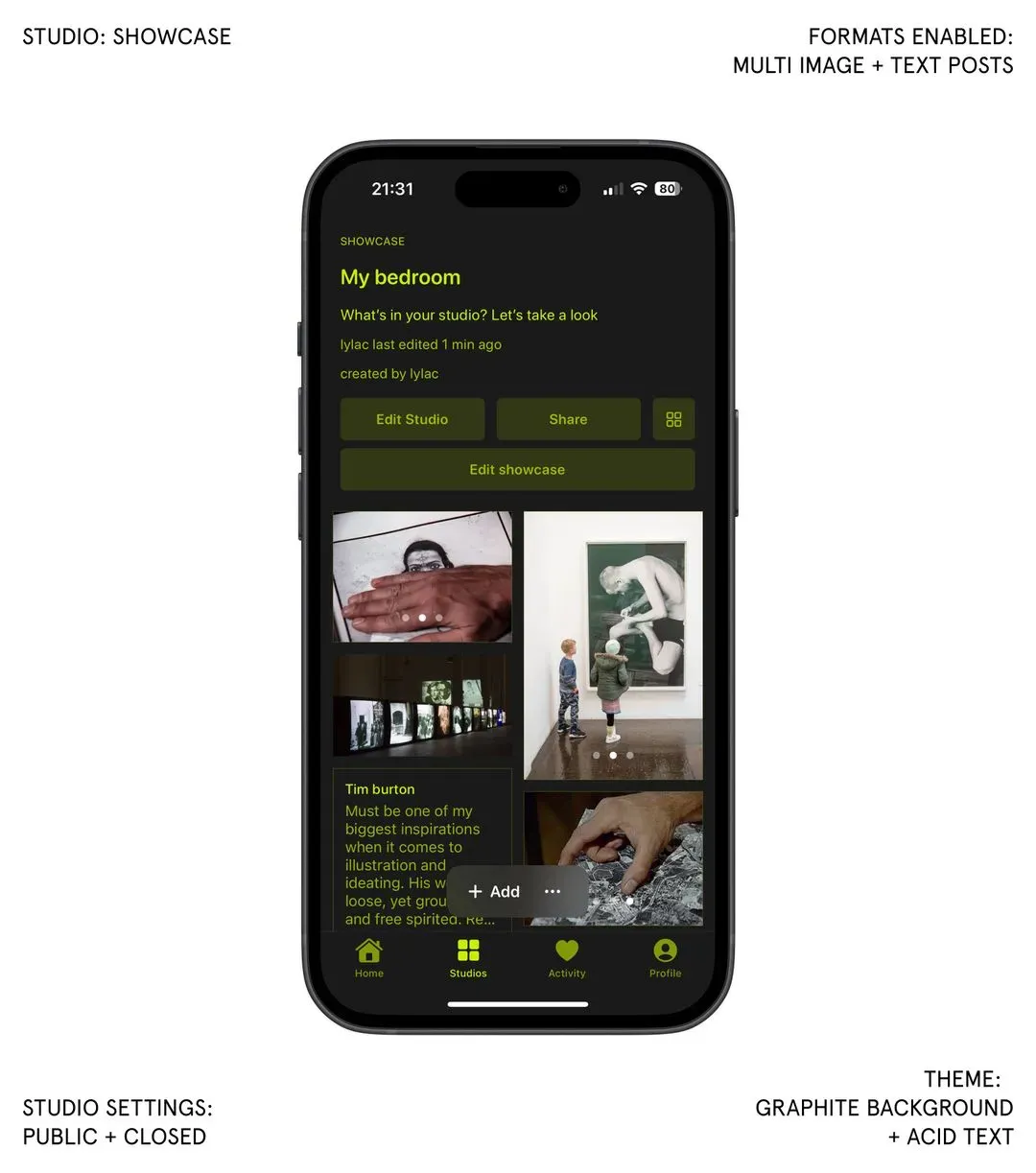
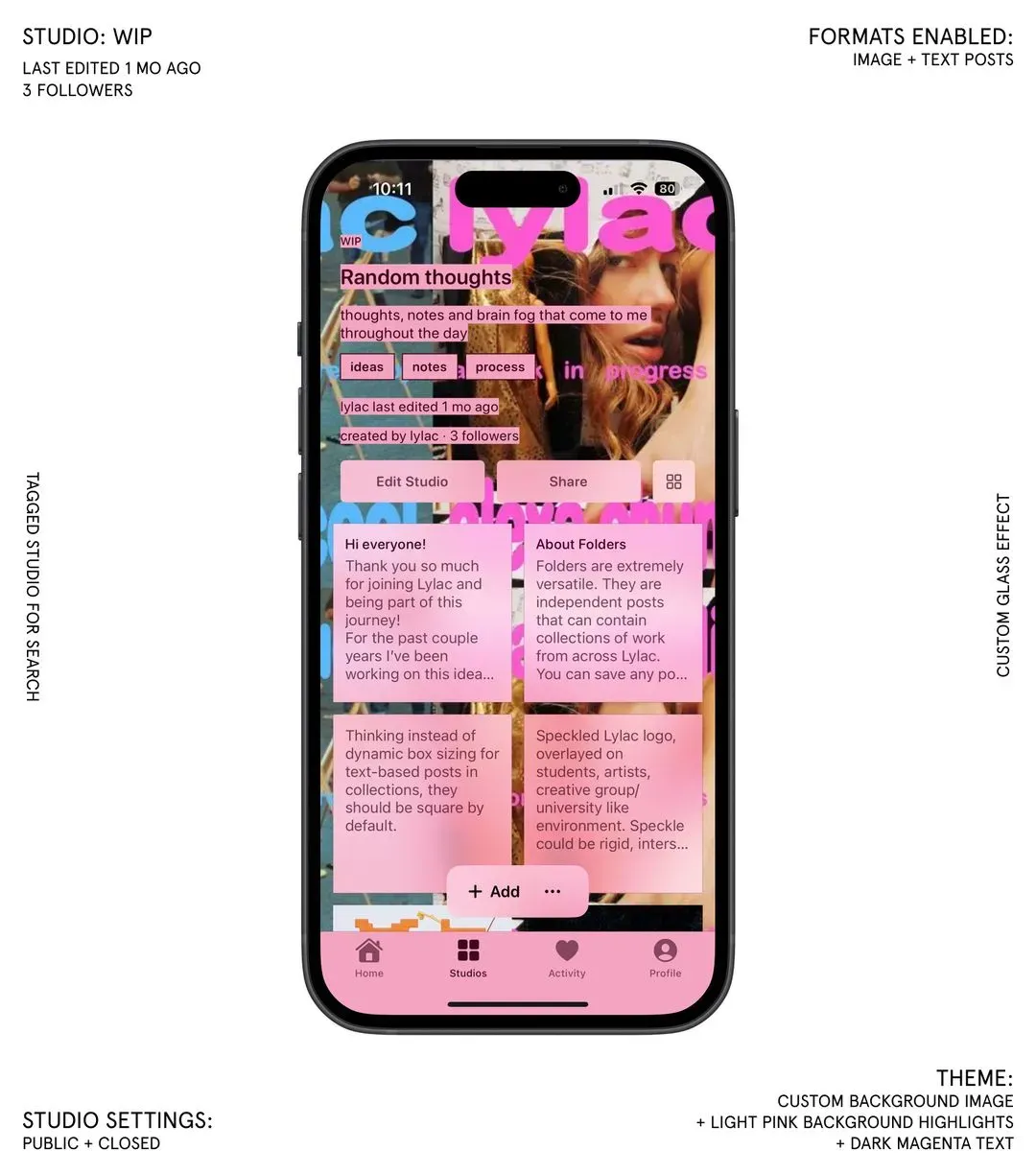
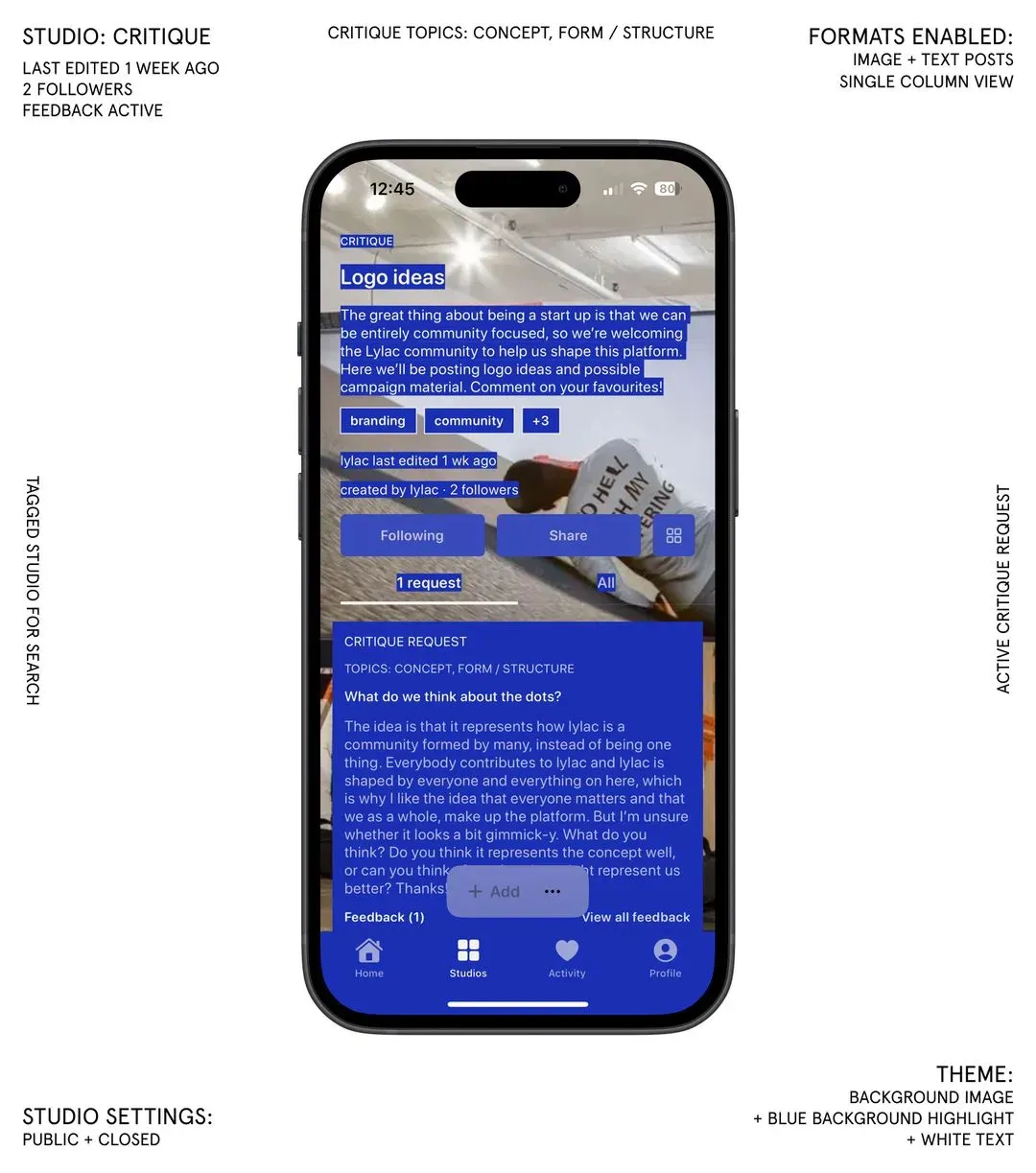
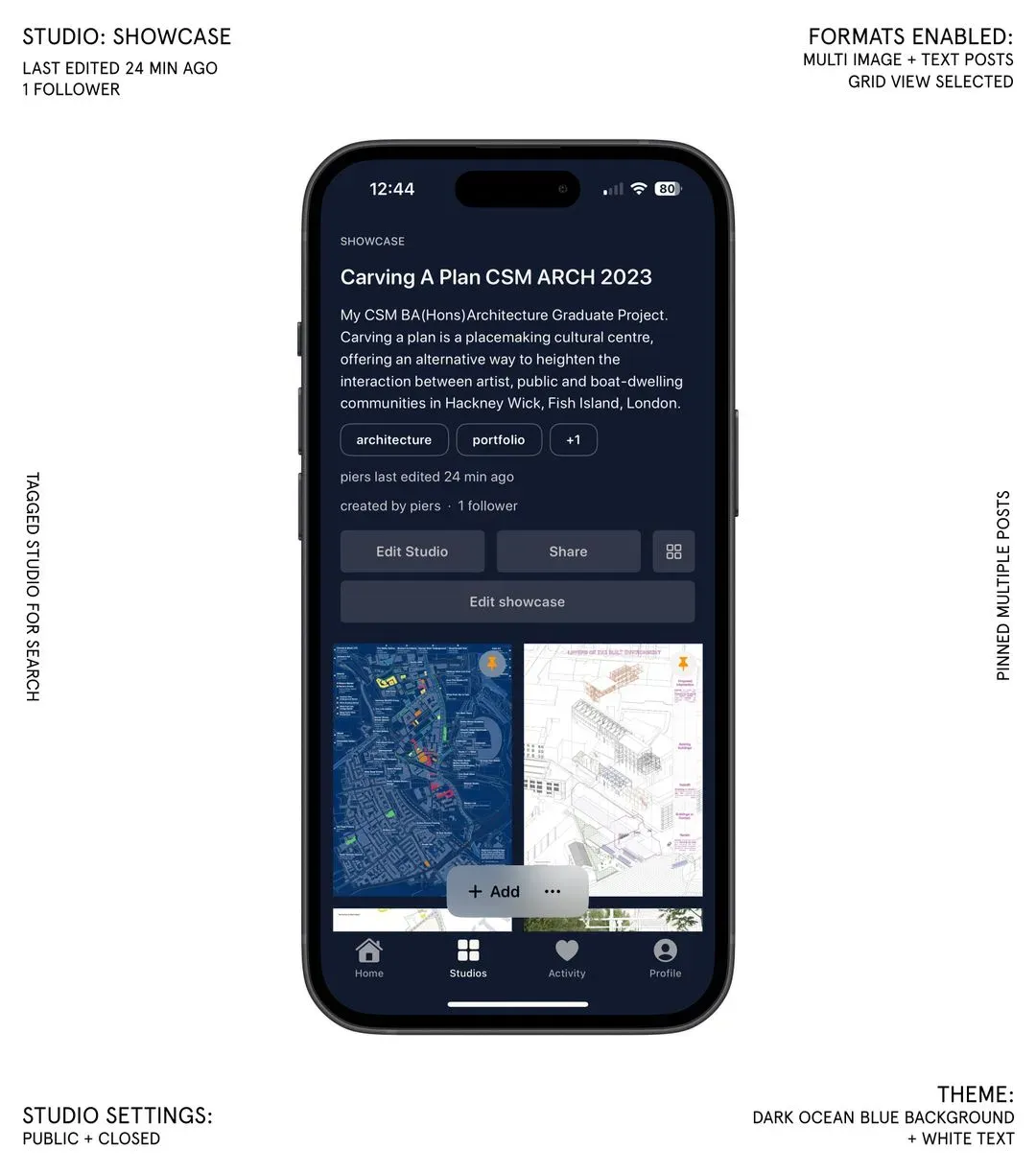
In the next update landing this weekend (14 February 2026), studios on Lylac become less like folders and more like rooms. We’ve been thinking about what made university studios work: not the fluorescent lights or the desks, but the atmosphere. The way a space could shift depending on what you needed from it: messy, critical, polished. Online, everything collapses into one endless feed. We want your studio to feel inhabitable. Changeable. Intentional. So we’re introducing STUDIO MODES , three distinct environments you can move between depending on where you are in your process. 1. WIP: This is your working table. Everything lives here. Sketches, half-formed ideas, experiments, drafts. Nothing hidden, nothing overly curated. It reflects the reality of making: iterative, layered, unfinished 2. CRITIQUE: Switch your studio into Critique mode and it becomes a site of dialogue. As a creator or admin, you can publish a dedicated ‘Request Critique’ post, focused on a specific idea, question or concept. These requests sit within their own REQUESTS tab, separate from the rest of your work, so feedback feels deliberate rather than lost in a stream. Studios in this mode carry a visible CRITIQUE stamp on their preview cards, signalling to others that you’re actively inviting conversation 3. SHOWCASE: For when you need precision. In Showcase mode, you can select and deselect which works are visible, shaping the studio into a considered presentation space. It’s ideal for portfolios, applications, or simply highlighting what feels resolved. Not everything that sits in WIP has to appear here This update is part of a wider shift. We don’t want studios to behave like profiles competing for attention. We want them to function like spaces you can actually work inside: places to develop ideas, collaborate, present, question, refine. Not just display. Because making isn’t one state. And your studio shouldn’t be either. Piers
Writing 18

Lylac is not about performing creativity

There is a difference between sharing creative work and performing creative identity. A lot of online spaces blur that line. The pressure is to appear constantly active, constantly certain, constantly legible. But real practice is rarely that neat. It moves in fragments. It disappears and returns. It changes tone. Lylac is built with that in mind. It is not trying to turn creative life into spectacle. It is trying to offer a more grounded environment for people who care about the work seriously and want somewhere that respects the shape of that process .

Project 19

What is a studio on Lylac?, image 1What is a studio on Lylac?, image 2What is a studio on Lylac?, image 3

A studio on Lylac is not just a portfolio page, and it is not just a folder either. It is a creative space that can hold work as it develops. A studio can be built around a project, a body of research, a practice, a theme, a discipline, or a collaboration. It can be public or private. It can be personal, shared, rough around the edges, or presentation-ready. What matters is that the work stays in context. On Lylac, the point is not only to show what you made. It is also to show how you think, what led you there, and what might happen next.

Writing 20

About Folders

Folders are extremely versatile. They are independent posts that can contain collections of work from across Lylac. You can save any post you see on Lylac into one of your folders. Since any type of

Writing 21

What can you post on Lylac?

Lylac doesn’t work like traditional platforms. Since we’re focused on catering for creative people and practices, it can’t just function like everything else. So what can you post on Lylac and why? P

Writing 22

Hi everyone!

Thank you so much for joining Lylac and being part of this journey! For the past couple years I’ve been working on this idea and since December I started coding Lylac myself. Lylac is a new platform

Writing 23

What is Lylac?

Lylac is a space for creatives, designers, artists, makers, writers, students, photographers, musicians, and anyone building a creative practice. It’s made for sharing work, collecting ideas, finding people, discovering studios, and building a creative world around yourself, without everything being reduced to likes, trends, or algorithms. Think of it as a living creative network.

Project 24

Three ways people use studios, image 1Three ways people use studios, image 2Three ways people use studios, image 3

Not every studio has to do the same job. Some people use lylac as a place to document work-in-progress. Some use it to ask for feedback and invite dialogue. Others use it to shape a cleaner public-facing presentation of their practice. Many move between all three over time. The point is flexibility without losing coherence. A studio can meet you where the work actually is, instead of forcing everything into one mode of self-presentation.

Made with Lylac